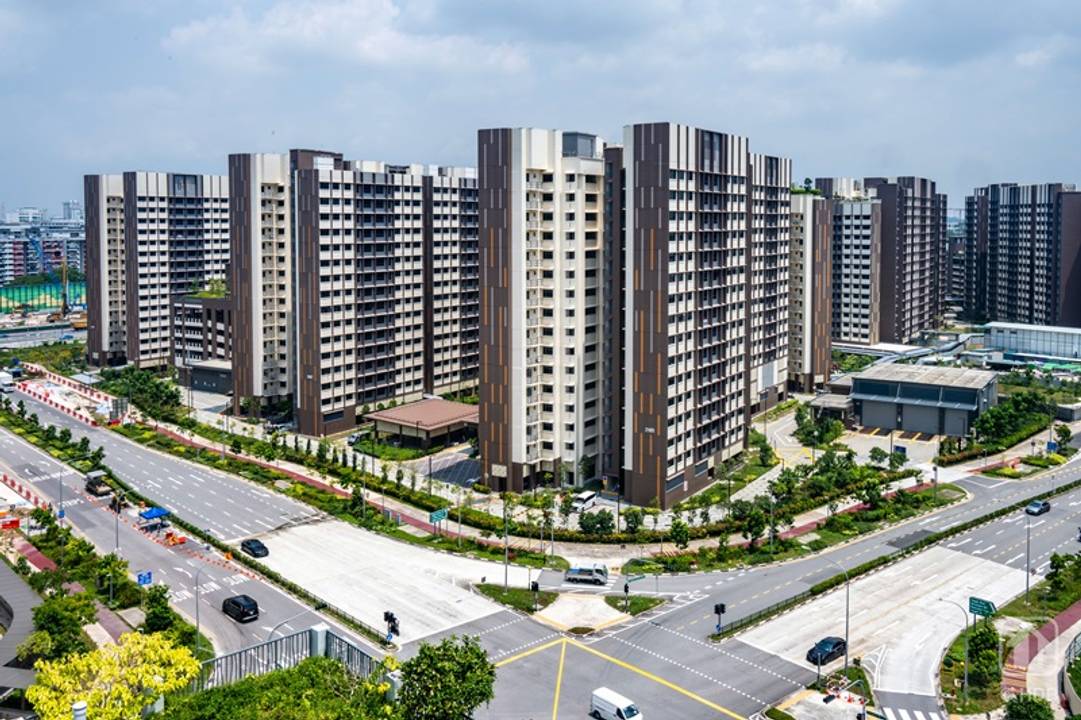
Singapore’s Housing & Development Board (HDB) has completed its first Construction Transformation Project (CTP), Garden Waterfront II @ Tengah, which aims to change the way public housing is built.
The second project, Garden Waterfront I @ Tengah, is on track for completion by the end of 2026. Through the use of advanced construction technologies and more productive building methods, both Build-To-Order (BTO) projects are expected to achieve the targeted 25% improvement in site productivity over the projected baseline productivity rate of 0.6 sq m/man-day.
Launched in 2022 in partnership with construction company Obayashi Singapore Pte Ltd, the CTP was conceived as a testbed for HDB to trial new ways of building more productively and safely, with less reliance on manpower. The 25% improvement in site productivity was achieved through a combination of measures, including greater prefabrication and the adoption of technologies that enabled tasks to be completed with more precision in a shorter time.
According to HDB, several innovations are now being adapted and progressively introduced into other BTO projects, helping the board to reap productivity gains on a wider scale as it continues to deliver a strong supply of homes.
“As Singapore’s largest housing developer, HDB is constantly looking for more innovative and efficient ways to build at scale. Garden Waterfront gave us the opportunity to test new technologies and construction methods in an actual BTO development and learn what works,” said Dr Johnny Wong, HDB’s deputy chief executive officer (building).
“We are now taking the successful innovations beyond this testbed and applying them more widely. This is part of our continued efforts to make construction safer, more productive and less manpower-intensive while delivering quality homes for Singaporeans.”
Greater standardisation and flexibility
One area explored under the CTP was how greater standardisation and prefabrication could make construction more productive, without compromising the design of the flats. At Garden Waterfront I & II @ Tengah, HDB adopted a fabrication system that allowed more structural works to be completed off-site, reducing the volume and complexity of work on-site. This minimised crane usage and manpower requirements, while easing coordination demands and site congestion, enabling works to proceed more efficiently.
In addition, by using more standardised, prefabricated building components and moulds that can be replicated and produced at scale, the modular system reduces reliance on manual labour and improves construction productivity. This higher level of standardisation also allows common precast components to be used across more HDB projects, giving the board greater flexibility to redirect supply where needed, thereby strengthening the resilience of its building programme.
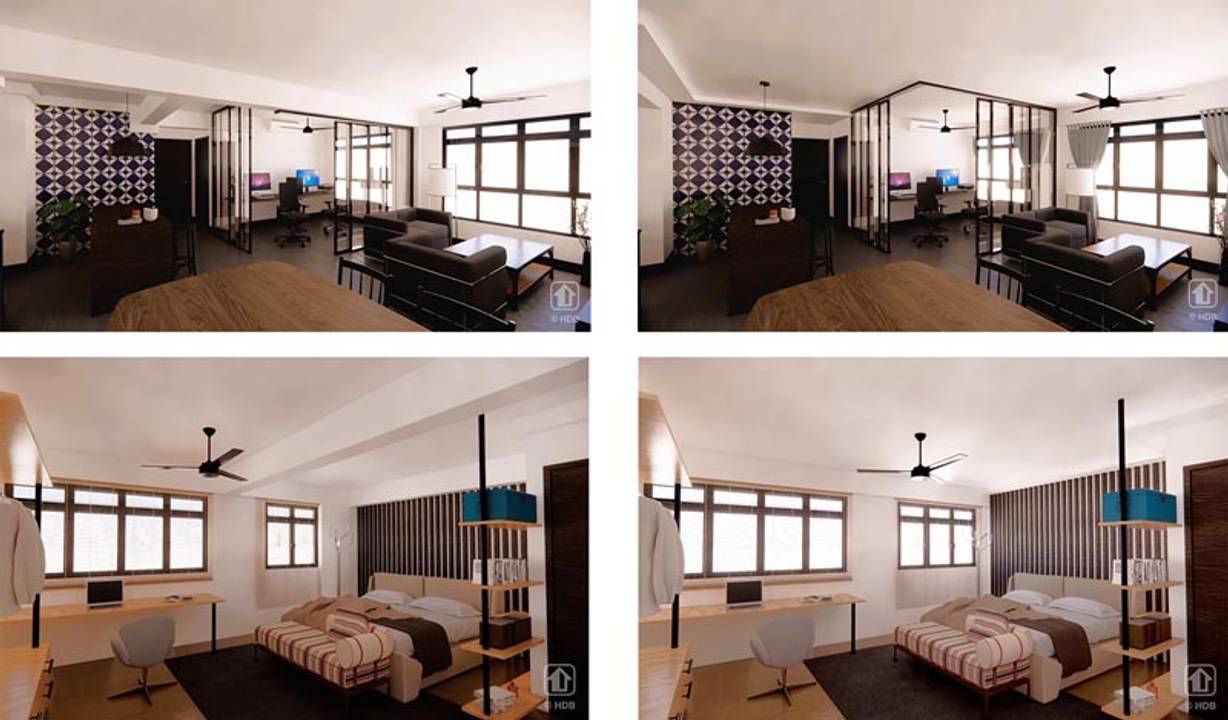
Based on this modular design, HDB subsequently developed flats with beam- and column-free living spaces, providing residents with more flexibility to configure their homes according to their needs. This design has since been rolled out to a total of six projects – in Bayshore, Bukit Merah, Kallang/Whampoa and Mount Pleasant.
Safer, more productive heavy lifting
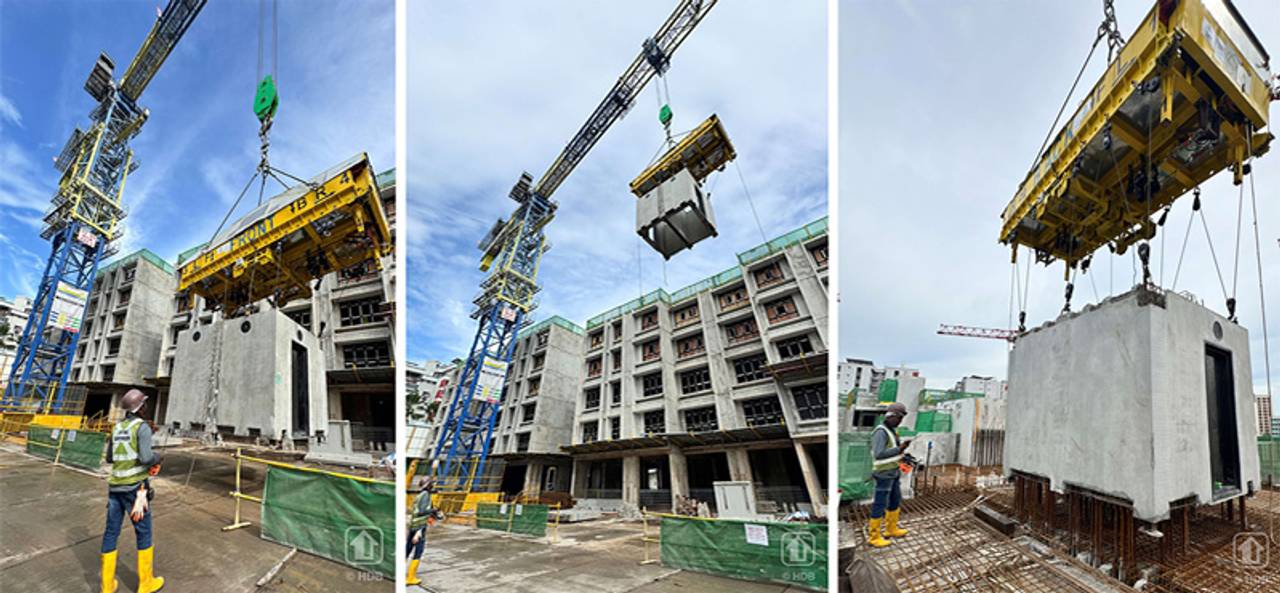
Lifting large and heavy precast components into position is an integral part of HDB construction. Traditionally, several workers are needed to manually guide and adjust the orientation of these components as they are lifted by cranes. Under the CTP, HDB piloted the SkyJuster, a gyroscopic device that controls the rotation and stabilisation of precast components during lifting operations. Used together with a tower crane, the SkyJuster required fewer workers to manually guide and adjust the components as they were lifted and installed.
Building on this technology, HDB has developed an intelligent lifting frame (ILF) in collaboration with the National University of Singapore and A*STAR. Using real-time sensing, the ILF can detect imbalances and enable the crane operator to remotely fine-tune the lifting points. This keeps heavy loads level, minimises swaying and facilitates more accurate positioning of precast components, while allowing workers to operate from a safer distance.
HDB said the ILF has the potential to improve productivity in the lifting process by up to 30%. The technology has been trialled in a Jurong West BTO project and is currently undergoing further refinement before wider deployment.
3D concrete printing
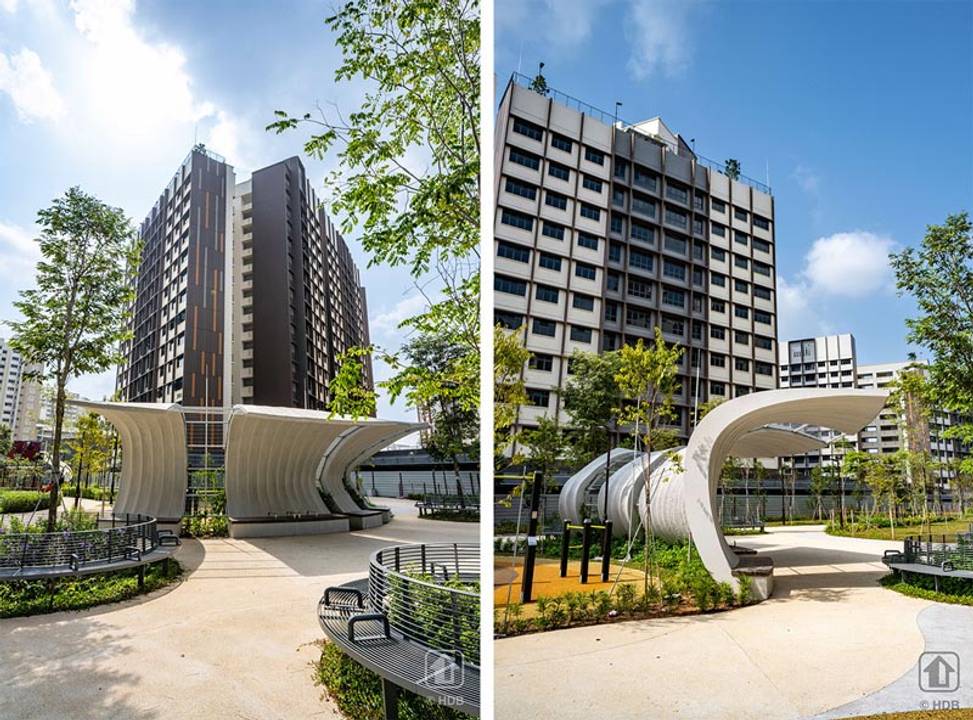
Under the CTP, HDB was also able to explore new possibilities with 3D concrete printing, creating complex architectural forms without the moulds and formwork typically required by conventional methods. One example is the botanic arbour at the common green between Garden Waterfront I and II @ Tengah. Comprising 22 uniquely shaped, curved segments, the structure was ‘printed’ at HDB’s Centre of Building Research in Woodlands. Measuring up to 13.6 m in length, 3.7 m in width and 3.6 m in height, the arbour is the largest 3D-printed freestanding landscape structure in an HDB development to date.
The structure was fabricated using a combination of 3D concrete printing and cast infill, with new fibre-reinforced concrete materials. Through parametric modelling – a smart, rule-based digital design process – and structural analysis, HDB and Obayashi optimised the thickness of each segment, reducing the volume of concrete required by an estimated 50% compared to a conventionally built structure of equivalent size.
Wider transformation
Innovation under the CTP extends beyond how flats are built to how residents can live more sustainably in their homes. HDB shared that Garden Waterfront I and II @ Tengah are the first BTO projects in Tengah where flats will be equipped with a smart adapter, enabling residents to monitor their household electricity consumption in real time.
Drawing on the learnings from the CTP, HDB will continue to work with industry and research partners to explore the next generation of construction solutions. This includes harnessing the growing capabilities of artificial intelligence and advanced robotics, as well as standardising more precast components, to develop solutions that can be deployed at scale.
All images: HDB