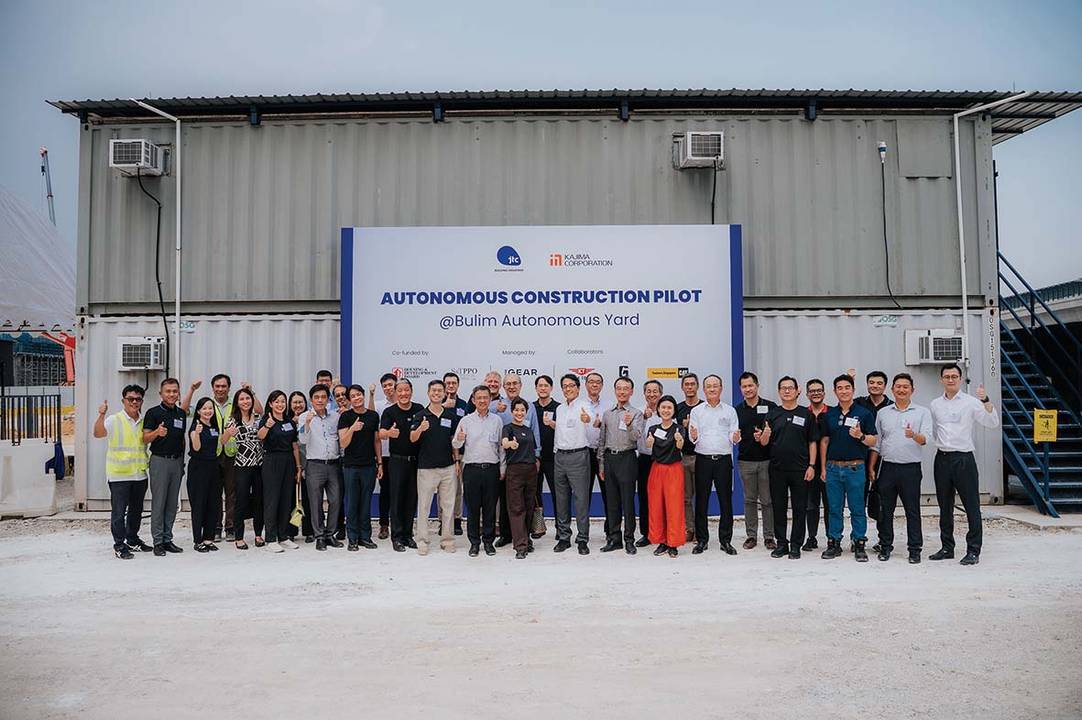
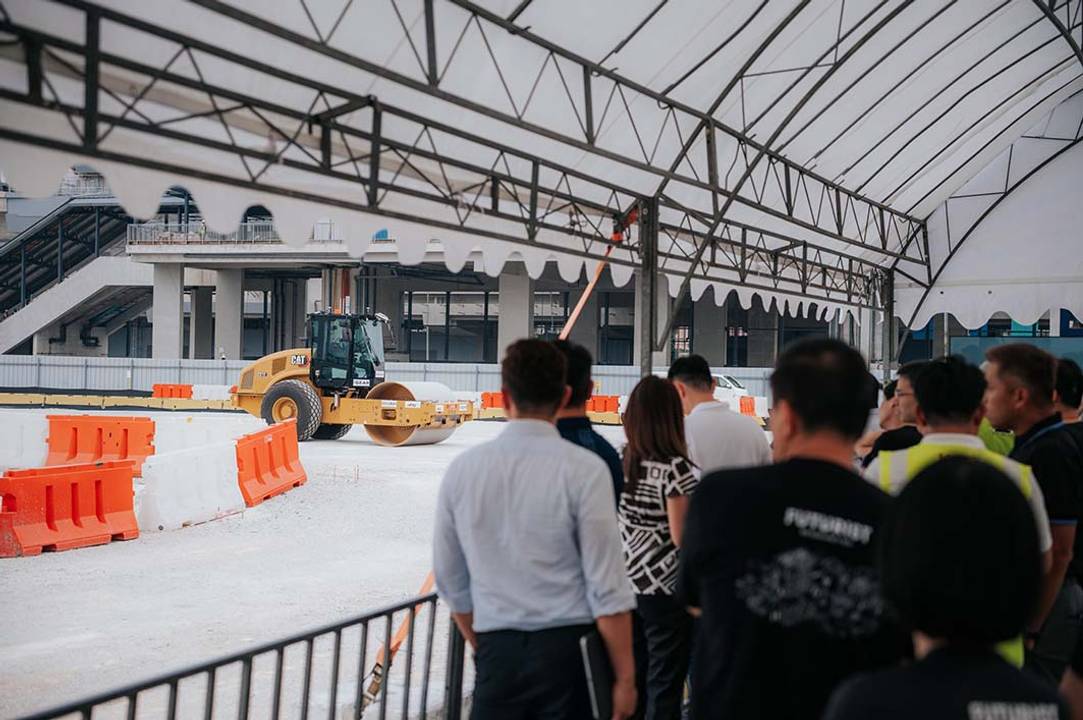
JTC Corporation and Japanese construction company Kajima Corporation have officially launched the first pilot project to explore the use of autonomous heavy construction equipment in Singapore.
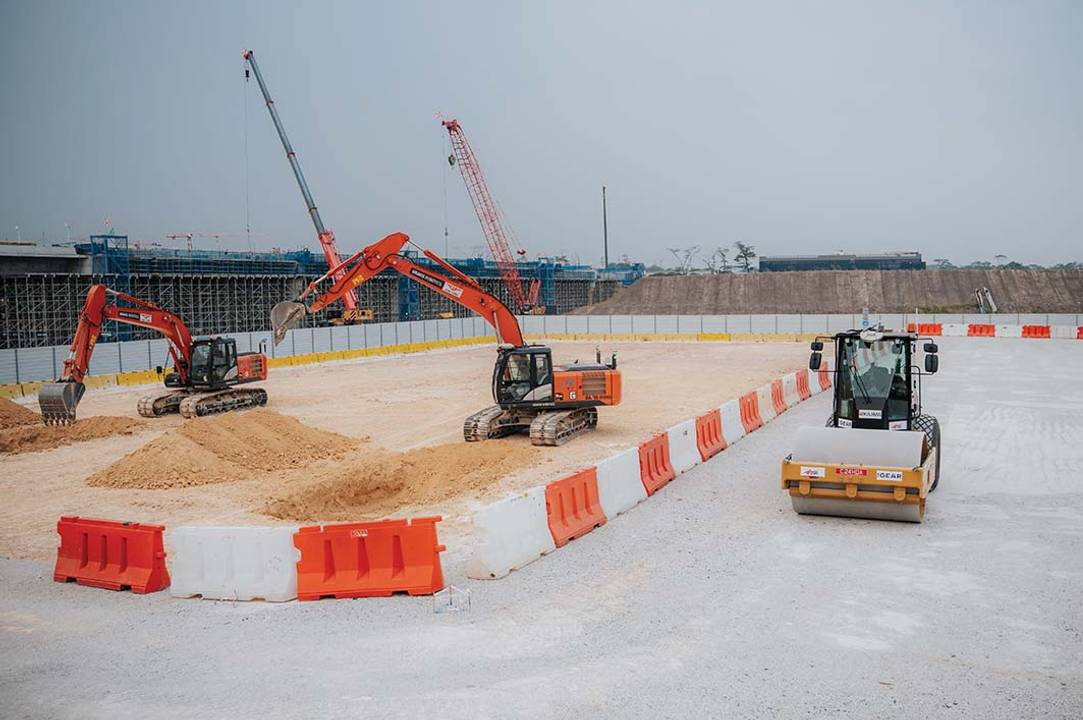
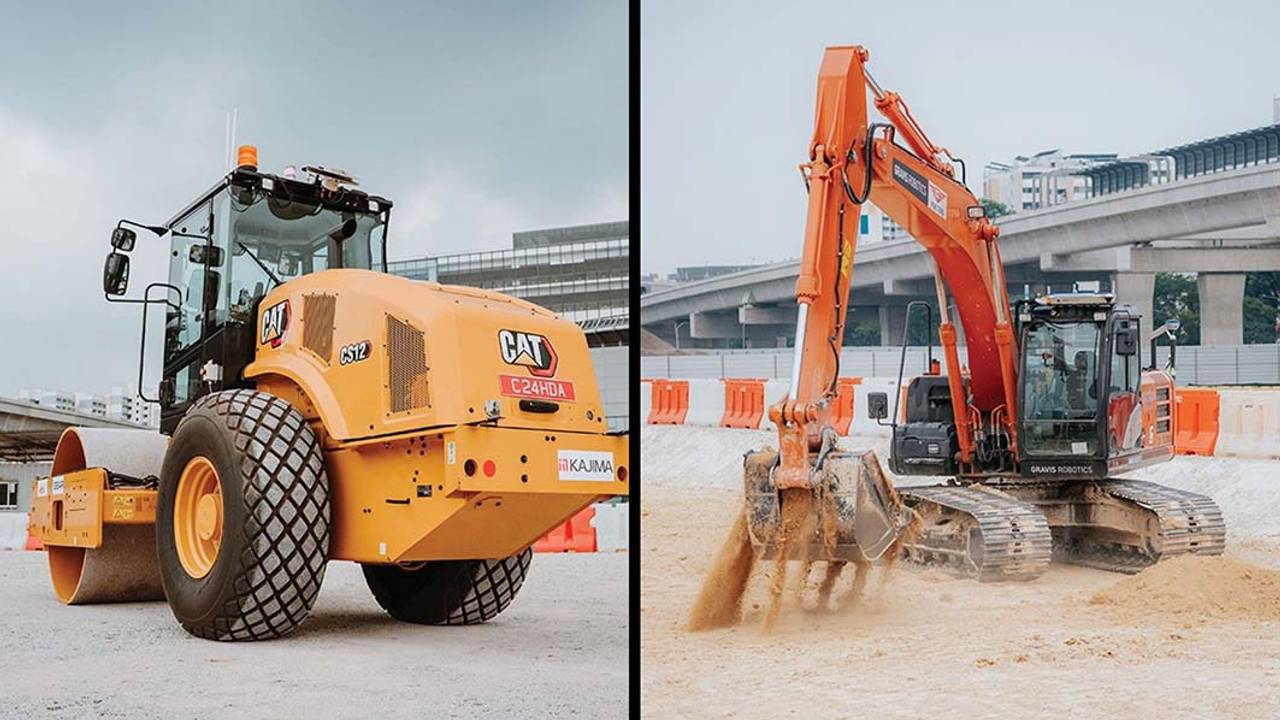
In the first phase, four autonomous machines – two excavators and two compactors – will be tested at the Bulim Autonomous Yard (BAY), JTC’s sandbox in the Jurong Innovation District for validating autonomous construction technologies under real-world site conditions.
Together with the Public Sector Science & Technology Policy & Plans Office (S&TPPO) and the Housing & Development Board (HDB), this pilot will test how these autonomous machines can ease Singapore’s construction manpower constraints and improve safety.
“For JTC, our upcoming projects include more than 800 ha of major earthworks in the next five years alone. And with this scale of work, we need to change the way we build and leverage emerging technologies to improve productivity, strengthen safety and make construction more resilient,” said Jacqueline Poh, CEO of JTC Corporation, speaking at the launch event on 16 September 2026. “Autonomous construction has the potential to help Singapore build faster, safer and better.”
As the government agency in charge of Singapore’s industrial development, JTC has been mandating the use of robotics in its construction tenders since 2025 to achieve higher productivity in the sector.
Raising productivity with less manpower
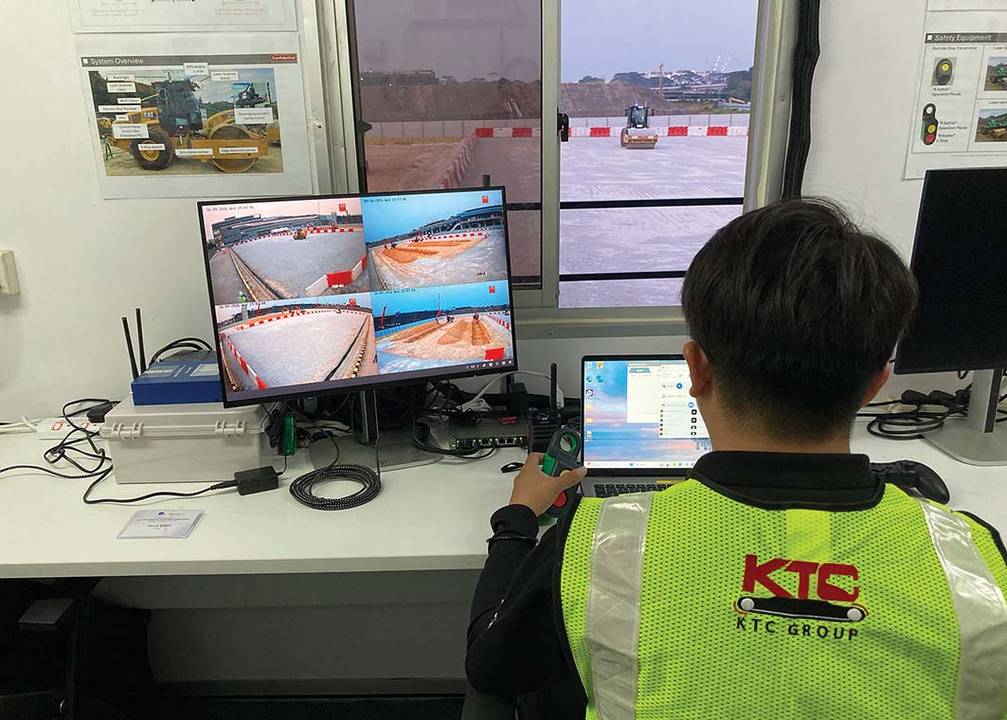
Under the trial, an operator assigns tasks and sets virtual geographic boundaries (geofencing) for each machine. Equipped with sensors and artificial intelligence (AI), the machines then carry out these tasks autonomously. The activities are monitored remotely by staff, who will intervene whenever an issue arises. JTC is currently targeting a 50% reduction in manpower, with one operator overseeing two machines.
Luke Wu, managing director of The GEAR by Kajima, highlighted the significance of the trial. “While the technology exists, the real challenge is adapting it for use in the Singapore context,” he said at the launch event. “That’s why sandboxes like the BAY are so important, as they give us a site-realistic environment to validate the equipment.”
This pilot involves multiple technology partners. To automate digging, the excavator uses a retrofit kit from Gravis Robotics, a Zurich-based startup that develops autonomous software and hardware for earthmoving equipment. Similarly, the compactor runs on Kajima’s A4CSEL system, marking its first deployment outside Japan. Retrofitting is an important design feature that lowers the barrier to adoption, as contractors can upgrade machines they already own rather than replace entire fleets.
“Singapore offers an innovation-driven environment where new technologies can be tested, refined and put into practical use. At the same time, the government has established a clear direction for construction automation and set out long-term plans for major infrastructure works, including land reclamation and projects to raise land levels to strengthen resilience against rising sea levels. Together, these policy-driven and long-term plans create a strong foundation for developing and applying technologies such as A4CSEL in Singapore,” said Yoshihiko Riho, senior executive officer at Kajima Corporation, who was also present at the launch event.
“Through close collaboration with JTC and our local partners, we will advance the development of automated construction technologies that enhance productivity, safety and quality while addressing the challenges facing Singapore’s construction industry. We believe the combination of Kajima’s technologies and Singapore’s innovation-driven environment will help realise the next generation of construction.”
Keeping workers safe
Autonomous construction equipment has the added advantage of reducing workers’ exposure to some onsite safety hazards by minimising the need for personnel to operate machinery or work in close proximity to moving equipment.
Arising from the BAY trials, JTC is working with the Ministry of Manpower (MOM) to develop operating guidelines and safeguards to support industry-wide deployment while prioritising human safety. These include geofencing to keep machines within designated areas, LiDAR sensors to detect humans and obstacles, and emergency-stop controls on site and in the control room.
Upgrading machines and skills
Scaling autonomous construction will require new skills in data interpretation, digital task planning, system integration and maintenance. As these capabilities are still nascent in Singapore, Kajima is working with local contractor Kok Tong Construction (KTC Group) and equipment provider Tractors Singapore Limited (TSL) to retrofit conventional equipment with autonomous capabilities, train Singapore-based operators and engineers, and document lessons from the pilot for wider industry adoption.
Mr Wu outlined the three main objectives of the pilot. The first, he said, is to retrofit existing machines. “The aim is not to reinvent the supply chain or get our contractors to restock their inventories.” The second objective is verification – determining whether autonomous technology can work under local conditions – while the third focuses on building the capabilities of local operating partners.
The project kicked off in January 2026, with a soft launch in May, shared Mr Wu. Phase 1 is scheduled to run until the end of the year.
Next phase
JTC and Kajima will also explore extending the trial to autonomous bulldozers and dump trucks in 2027 (Phase 2), creating a coordinated fleet of machines.
“The real value of autonomous systems happens when we go beyond just individual machines. We have to consider how they can work together across actual construction processes,” explained Mr Wu.
“Earthworks is a particularly suitable example because it involves a series of connected and repetitive activities. The material needs to be loaded, hauled, spread and compacted. Each of these activities that follow one after the other needs to be coordinated. And that’s where I believe Phase 2 can take us further.”
“The objective of Phase 2, put simply, is to identify a use case for Singapore’s context, because we need to build a technical foundation before we deploy [the technology] on an actual project,” Mr Wu pointed out. “So, Phase 2 has to be about proving that autonomous construction is possible.”
“Our ambition goes beyond these initial few machines,” added Ms Poh. “Over time, we want to expand the range of heavy construction equipment that can operate autonomously and ultimately [move]towards multiple autonomous machines working together as an orchestrated fleet.
“With more than 800 ha of major earthworks in the pipeline, we do think we have a real opportunity to translate what we learn here into deployment at scale, particularly at large sites, such as our reclamation projects.”
Beyond the pilot, JTC will be collaborating with public agencies, contractors, equipment providers, research institutions and technology companies to conduct more autonomous construction trials at the BAY sandbox.
Image credits:
Images 1-2, 4-5: JTC and Kajima
*JTC’s sandbox is open to firms looking to test innovative technologies under real-world site conditions and support the advancement of Singapore’s construction sector. Interested firms may contact JTC directly: askjtc@jtc.gov.sg
Note: This story has also been published in the Sept/Oct 2026 issue of SEAC (with more images). Click here to read it online or here to download the PDF (pages 30-35 and 37).