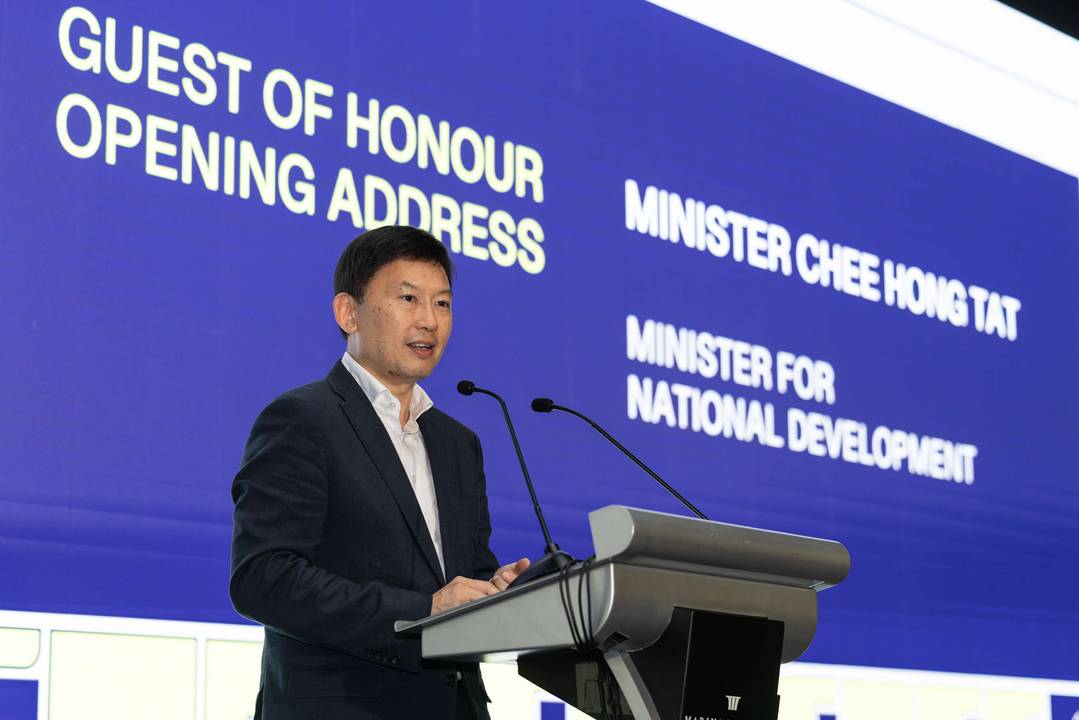
The Building and Construction Authority (BCA) released preliminary findings from a study on 22 July 2026, demonstrating the business case for investing in Design for Maintainability (DfM) features. By incorporating these features early in the design process, developers, building owners, and tenants can expect to benefit from substantial maintenance costs and manpower savings over a building’s life cycle.
Revisions to the plans to mandate CORENET X adoption were also announced, following a review of early adoption projects and industry feedback. These refinements will support a more calibrated and targeted approach to CORENET X adoption.
Designing for long-term resilience
Demand for building maintenance works continues to increase as Singapore’s building stock grows and ages. At the same time, the manpower available to maintain buildings continues to shrink as the population ages.
To ensure that buildings remain well-maintained over time, BCA has been advocating the BE sector to adopt Design for Maintainability, or DfM. This entails factoring longer-term maintainability considerations into the design process, so that buildings are easier and more cost-effective to maintain through their operational phase.
Key findings from the study
To quantify the benefits of DfM, BCA worked with Surbana Jurong (SJ Group) to study four local developments—two existing commercial buildings, one new commercial development, and one new residential development. The study used the Green Mark Maintainability (Mt) framework and life-cycle cost analysis approach.
The findings showed that adopting DfM can yield annual operational savings and deliver net positive returns after relatively short payback periods. Across the three commercial buildings studied, potential annual operational savings from adopting DfM ranged from $310,000 to $950,000, with the majority of DfM measures achieving a payback period of less than six years. For the residential development, potential annual operational savings can be up to $110,000, with the majority of DfM measures achieving payback within five years.
For example, without dedicated access built into the design, maintenance workers servicing the fan and basin at the top of a cooling tower would need to rely on temporary scaffolding—a costly and time-consuming exercise every time routine maintenance is required. By incorporating a cat ladder into the design, maintenance teams can gain safer and more direct access to the cooling tower. In the case of Shaw Tower, this straightforward design decision can generate potential life-cycle savings of over $750,000, with a payback period of just three years. Given that cooling towers typically have a lifespan of 15 years, recovering the investment in three years means net positive returns thereafter for the remaining 12 years.
The study also showed meaningful productivity gains from adopting DfM. All DfM features studied helped reduce annual maintenance man-days, with many achieving reductions of more than 60%. The largest gains came from architectural decisions such as choices about design specifications, floor materials, ceiling types, and façade access, underscoring the importance of making maintainability an upfront design consideration.
Across the buildings studied, the additional cost of incorporating DfM for the commercial buildings ranged from 0.6% to 1.5% of total construction cost, and was just 0.2% for the residential development.
Call to action for the industry
Developers and building owners are strongly encouraged to attain the Green Mark Mt Badge for their building projects to enhance the long-term performance, unlock significant savings over the building’s lifespan, and add value to their properties.
For developers seeking to sell units upon completion, the Green Mark Mt Badge provides added assurance of the asset’s long-term sustainability, cost-efficient maintenance requirements, and lower potential savings in maintenance costs. Architects and engineers are also encouraged to embrace DfM and actively apply maintainability considerations in their projects. This not only strengthens the value proposition for clients but also supports broader efforts to transform and future-proof the Built Environment (BE) sector.
BCA and SJ Group will work together with trade associations and chambers in the BE sector to hold a series of engagements with architects, engineers, developers, and FM practitioners to share the study’s findings and gather industry feedback on how DfM can be more widely adopted across the sector.
“For too long, maintenance has been treated as someone else’s problem—to be addressed only after the building is handed over. This study shows that designing for maintainability is not a cost burden, but a sound investment. By making maintainability a priority from day one, we can reduce long-term costs, improve productivity and create a more resilient built environment that serves future generations well. We encourage developers, designers, and building owners to embrace DfM and the Mt Badge, as we shift from building for completion to building for long-term performance,” said Mr Ang Kian Seng, Group Director of Environmental Sustainability at BCA.
“Design for Maintainability goes beyond making buildings easier to maintain. It is about embedding long-term resilience, enhancing asset value, optimising operational performance, and creating environments that support productivity throughout the asset lifecycle. As buildings become increasingly complex, connected and data-driven, the best outcomes are achieved through the seamless integration of design, engineering, sustainability, and smart facilities management from planning through to operations. At SJ Group, we believe this whole-of-lifecycle approach is essential to unlocking asset performance, reducing lifecycle costs, and delivering resilient, sustainable, and future-ready development,” added Praveen Hassan Chandrashekar, Regional Director (Asia), Sustainability & Resilience Office, SJ Group.
As more projects come onto CORENET X, agencies have been reviewing its implementation and engaging industry to understand its impact. The review found that the benefits of CORENET X are more significant for larger and more complex projects, which typically involve more agencies and regulatory submissions. Early coordination through CORENET X helps these projects surface and resolve issues earlier, reducing downstream delays.
From 1 October 2026, all new projects with Gross Floor Area (GFA) of 5,000 square metres and above will be required to make submissions via CORENET X. It will no longer be mandatory for projects with GFA below 5,000 square metres to make submissions via the CORENET X gateway processes. Ongoing projects on CORENET 2.0 and projects with GFA below 5,000 square metres can continue to use CORENET 2.0 to make submissions for now.
These refinements reflect authorities’ continued commitment to building a more future-ready Built Environment sector, adopting digital transformation where it matters most and delivers the greatest value.